
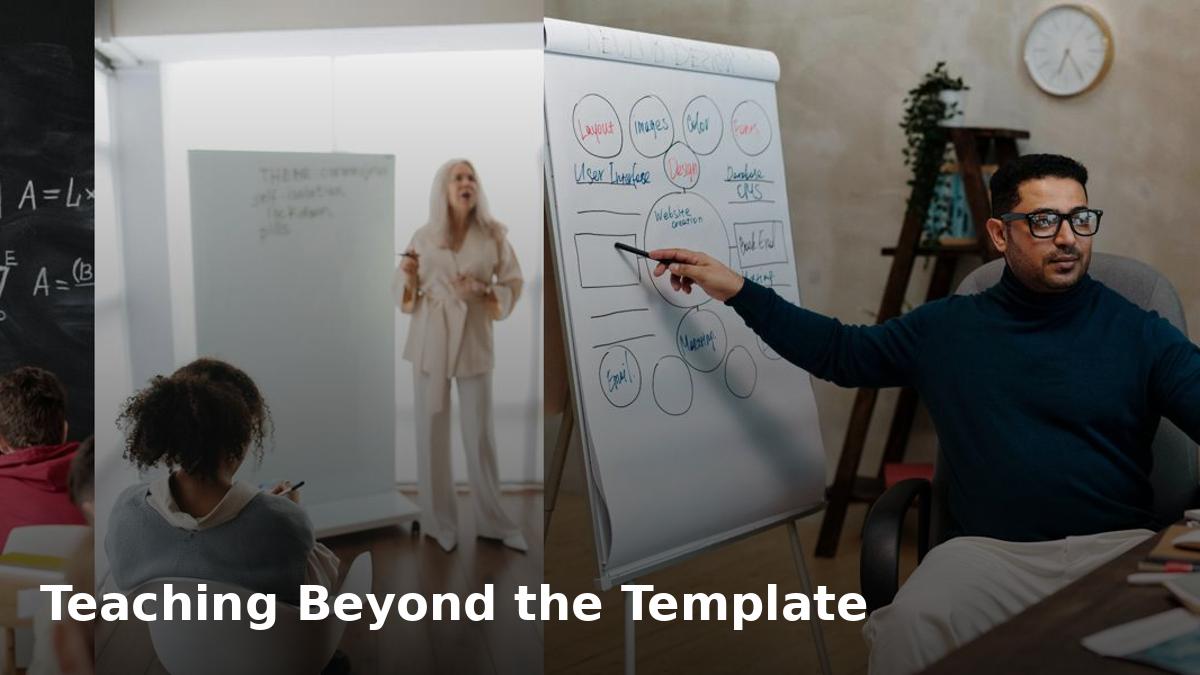
If you have ideas that address the loss of quality in compressed courses, the ways student use of AI can diminish learning, or how standardized courses dehumanize the educational experience, please submit them to oduaaup@protonmail.com.
Humanizing Online Courses
This first entry, to get the ball rolling, comes from an AAUP member concerned about the loss of personal connection in courses where faculty are told in advance how content should be delivered and where instructional materials are standardized.
In her search for solutions, she came across the work of Michelle Pacansky-Brock.

Pacansky-Brock emphasizes that teaching—especially online—should not be reduced to the efficient delivery of content. Instead, learning is grounded in relationships between instructors and students. I think most professors can agree with this statement.
Dr. Pacansky-Brock’s insights are thoughtful and grounded in the scholarship of teaching and learning, as well as years of experience working with diverse student populations in online environments.
For ODU-AAUP members looking for practical ways to preserve human connection in an era of templates, standardization, and compressed delivery, her work is worth exploring.
Michelle Pacansky-Brock describes herself as a community college educator and “a teacher at heart.” On her website, she connects her teaching philosophy to a long personal and professional journey that includes community college teaching, online instruction, student-centered course redesign, and a commitment to more inclusive learning environments.
Her background reflects both personal reflection and classroom experience: she writes about discovering the importance of authentic connection with students, learning from student feedback, and recognizing how course design can create or reduce barriers to success.
A good place to start is her guide: “The How and Why to Humanize Your Class”
Members interested in browsing more of her work can visit: brocansky.com
A case for different cans: learning offline while clicking online
by Rod Graham
Where is it written that learning in an online course must occur online?
I came to ask this question by accident—ironically, even. I was trying to increase engagement in a traditional, in-person course. Each class meeting, I am confronted with a squadron of students sitting passively, staring blankly at me. No questions, no comments. One can take that personally after a while. And so, in the Fall of 2025, I found myself searching for a new strategy to grab my students’ attention and get them engaged.
I decided to take advantage of the thing they always bring to class: their phones. Connected to Wi-Fi, their mobile phones give them access to a library, a camera, an audio recorder, a word processor, and a communication network all at once. These are just some of the “affordances” of the cell phone, as technology scholars might say—the possibilities for action that a technology makes available.

Using phones in class is not entirely new for them, of course. My colleagues have been asking students to use their phones for attendance and polls for years. But I suspect those uses have kept the phone at the margins of the learning experience: a scan, a tap, and then back to the “real” class. What I am trying to do is blur that line. I don’t want the phone to be a peripheral tool, much less one that is prohibited. I want it to become a tool that facilitates learning, not unlike a calculator or index cards.
Sometimes I would link to a Google Form via a QR code. The answers they submitted on the form would then be used for class discussion. On occasion, I would ask them to visit a website and summarize the information.
As I get better at integrating these activities, I can imagine expanding them into group work, where each group has access to its own Google Doc. By the end of class, everyone can see what each group has produced. I could also have students conduct interviews with other class members and then play those interviews in class.
This is not overly technical. But it reminds me of an argument often made by those who favor online courses: that in an online environment, students cannot hide and must participate in discussion boards. I can create that same dynamic in an in-person class through the use of mobile phones.
I’m still tinkering with this—still refining it. But it has worked… most of the time.
One reason it may not be as effective as it could be is how I think about grades. I don’t attach points, grades, or extra credit to these activities. Students are trained from an early age to see education as an exercise in earning—points, grades, credentials. In this view, there is no learning without earning, and I’ve always resisted that.
For me, grades degrade. It’s a personal belief that others may not share. But as a result, once students realize there is no grade attached to their participation, the most grade-focused among them see little value in the activity and merely go through the motions.
But the hyperfocus on credentials is a problem for another day.
What I am doing with these activities, at least in theory, is trying to bring the digital environment—through the portal of the cell phone—into the physical environment of the classroom.
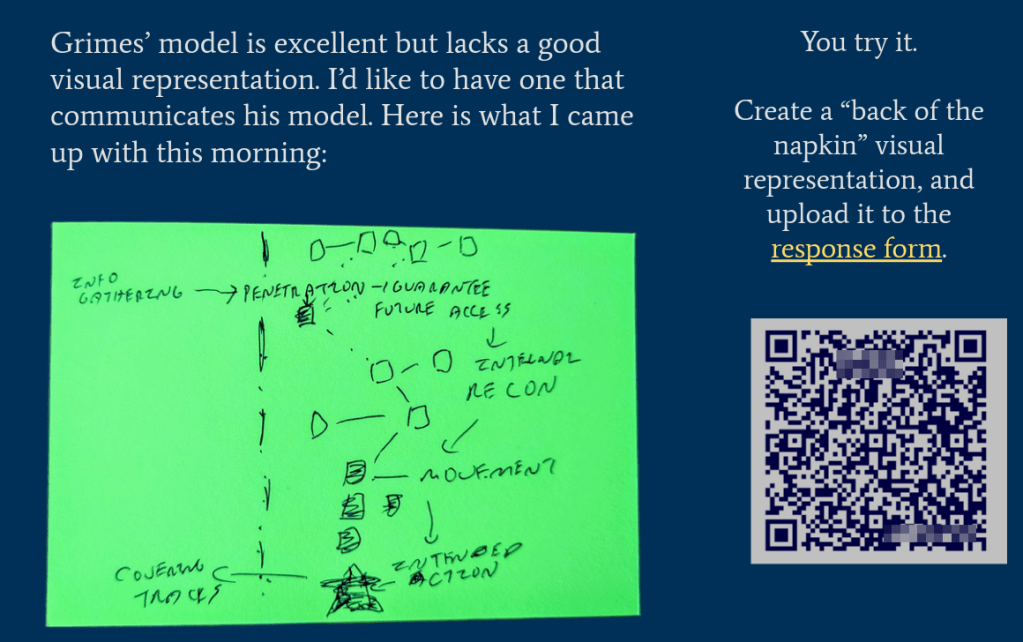
Perhaps I am late to this. I know my colleagues have been leveraging cell phones for years. But for me, it has been something of a revelation.
And it led to a new thought: Can’t this work in the opposite direction?
The universal can opener
Whether a student is using a laptop, a tablet, or a mobile phone—whether they are a traditional student in town taking one course online or halfway around the world as a fully online student—they still exist in a physical environment. Moreover, they have bodies and emotions. They have senses. They are embedded in social contexts with other human beings.
Why not recognize that reality and make it part of the learning process, rather than sacrificing our humanity at the altar of what we call “online” learning?
So again, where is it written that learning in an online course must occur online?
Sure, a learning management system (LMS) like Blackboard or Canvas, at its most foundational, is a platform for communication and record-keeping—an assignment is communicated by the professor, and the student responds; an evaluation is communicated to the student, who, it is hoped, will respond accordingly in future assignments; and all of this is recorded securely.
But must the actual work—the activities students do to cultivate knowledge and skills—be confined to the LMS?
One immediately recognizable benefit of this approach is that it can help mitigate the impact of artificial intelligence on learning. The more activities that ask students to be human—using the whole body and all its senses, and engaging in real-world interaction embedded in social contexts—the less a computer can approximate them. This may be the first reason many would adopt this kind of strategy.
But I don’t want to give the impression that I am against the use of AI. Not in the least.
Indeed, I’ve found it more productive to allow students to use artificial intelligence rather than attempt to exclude it. In this view, AI becomes another variable that students must incorporate into their judgment. By openly embracing it within assignments, rather than designing around it, the work becomes less easily gamed by AI. It is also more reflective of how thinking actually unfolds in contemporary work environments (ChatGPT and I have been in conversation about this piece for a few days now before I posted it to our site). So most of my assignments do not restrict the use of AI for information gathering, grammar, idea generation, and so on. But for those critical of this pro-AI view, the ideas presented in this piece are still useful.
For me, I’m drawn to the ideas discussed here because they push back against the growing reliance on standardized, pre-structured courses—you know, the ones in cans. This is a way of teaching beyond the template.
We push back against these canned courses for obvious reasons. Within disciplines, they are pre-designed, click-through experiences constructed without regard to the individuality of the student, the professor, or the historical moment in which the course is taken. I can build a sociology course and simply pass it on to another instructor, who then watches as students click through it.
Across disciplines, they begin to look like the same kind of can. The aesthetic of courses—their design and organizational logic—is the same. When activities are administered (weekly) and how they are clustered (one or more modules) are the same in physics as they are in criminal justice. Even the activities themselves (required AI integration, peer collaboration spaces, and so on) are largely the same, regardless of professor, discipline, or level.
A course is a course is a course; a student is a student is a student; a teacher is a teacher is a teacher. Many find this approach, which harkens back to industrial-era assembly lines, “forward-focused.” They see the reduction of the wide range of human learning experiences to a single pre-approved template as “innovative.”
I don’t. Personally, it reminds me of my basic training – the drill sergeant and the private are primarily roles to be occupied. The personalities and lives experiences are not important to the process.
These canned courses run counter to the natural variability we encounter in everyday life—the variability that creates the cognitive dissonance needed for learning. Students come to recognize and anticipate the design of all their courses. They know where everything will be located, how it will be organized, and what will be expected. This familiarity is pleasing to students, who are, in this sense, customers, but it reduces the need to interpret, to navigate, to think.
Students in canned courses don’t have to deal with Professor A—brilliant but disorganized, teaching with nothing but their voice and a single black dry-erase marker. Nor do they need to muster the courage and verbal skill required to do well in Professor B’s course, who favors a Socratic style of teaching—arranging students in a semicircle and asking them question after question. And forget about that taskmaster, Professor C, who demands precision, preparation, and accountability at every turn—points are deducted for breathing incorrectly during class time.
In a canned course, all of that variability disappears. No quirks, no friction, no adjustment. Just a smooth, predictable path from module to module. Professors A, B, and C must funnel all of their human variability into… weekly discussion boards.
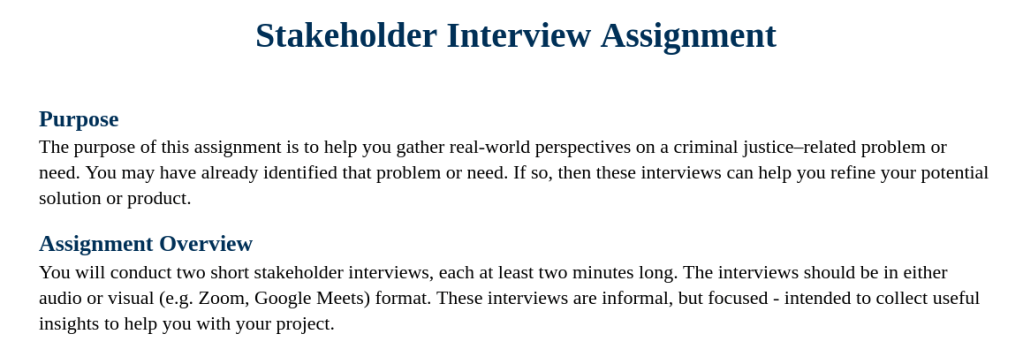
From this state of affairs emerges a particular kind of student adaptation. Students develop what might be called a “universal can opener.” They learn not the discipline itself, but how to complete coursework as efficiently as possible with minimal cognitive effort. They become skilled at navigating the structure rather than engaging the substance.
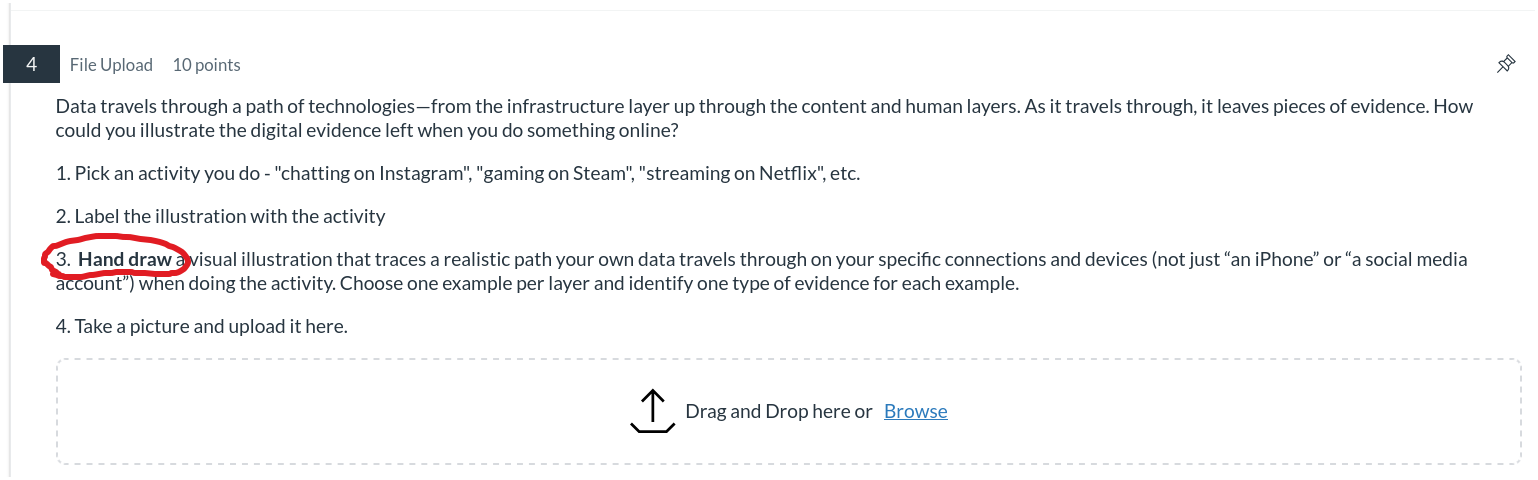
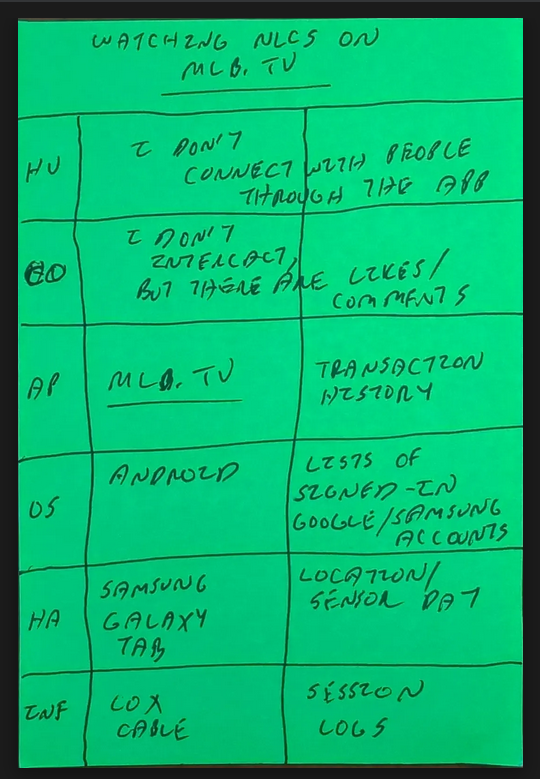
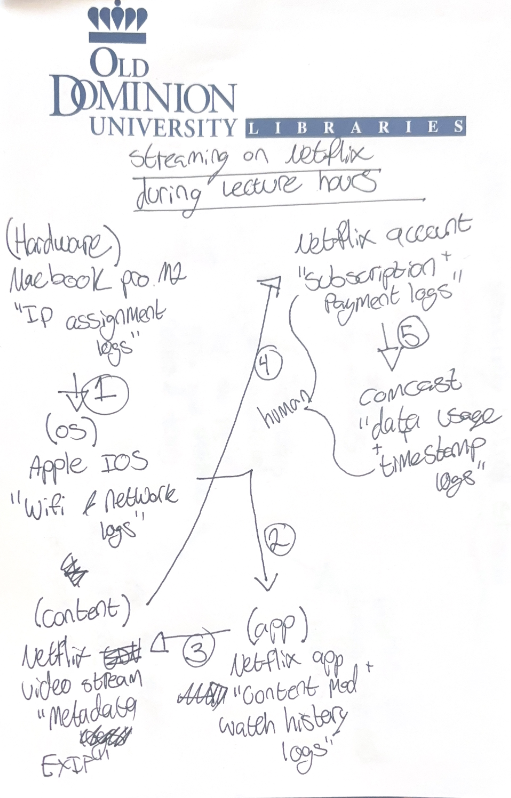
This is why I am interested in pushing students outside of this hyper-managed digital environment. It offers me more variability in how my “can” looks, as it were. It allows me to challenge them more. And to the extent that incorporating more of the physical environment into an online learning environment widens the array of assignments available, it might allow me to retain the individuality I cherish as a professor.

